
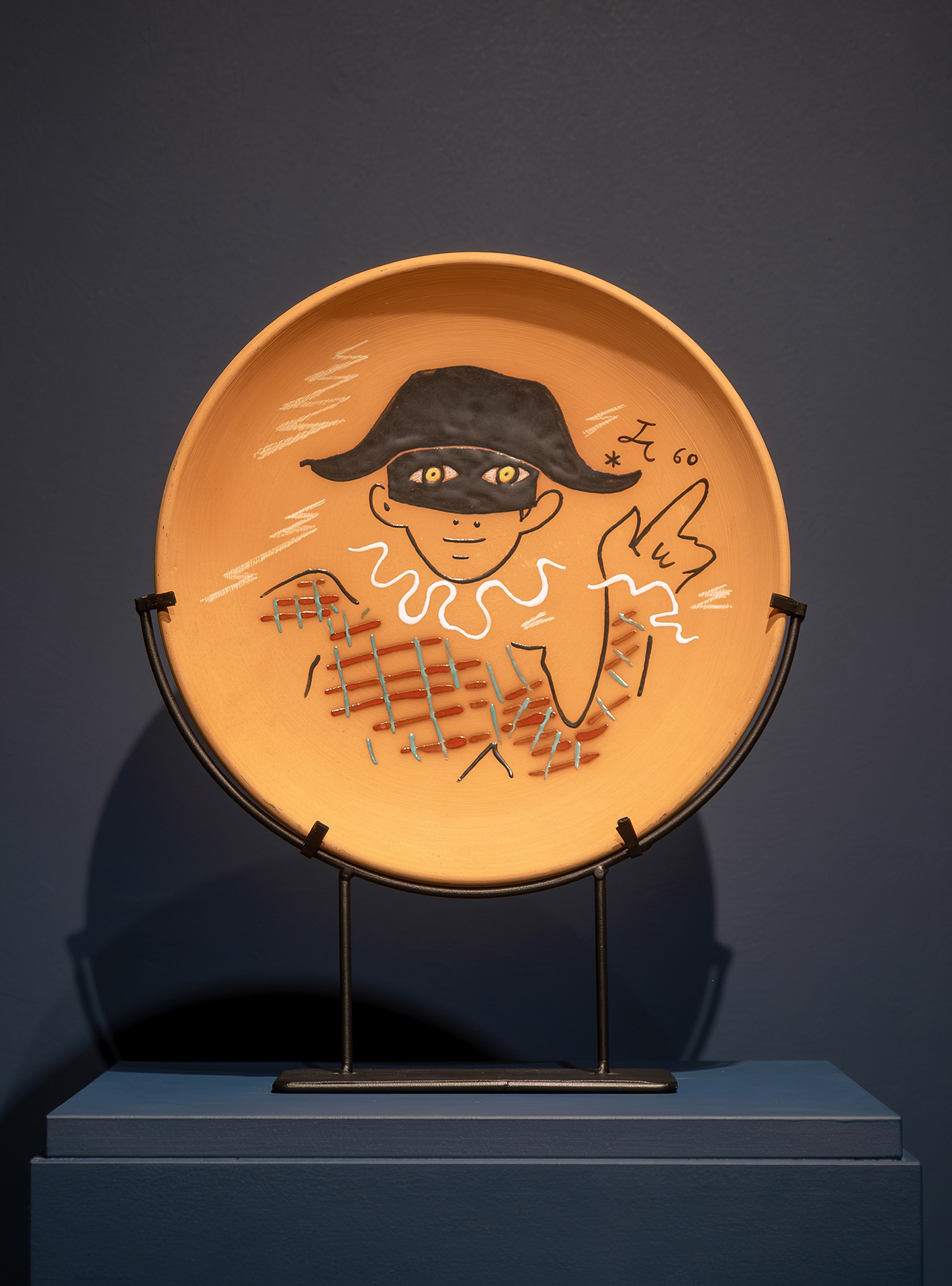
"The Masked Harlequin"
1960
Jean Cocteau began working with ceramics at the atelier of Marie-Madeleine and Philippe Madeleine in Villefranche-sur-Mer in late 1957, at age 68. He continued until his death in 1963. The idea was inspired by his friend Pablo Picasso, who had been experimenting with ceramics in Vallauris since 1947 and warned Cocteau: “If you start firing clay, you’re done,” hinting that it would consume him. Cocteau, ever eager for new challenges, embraced the risk. In a 1958 interview, he said: “Pottery saved my life! It frees me from ink.” Ceramicsbecame a return to his roots: as a poet and an artist, he drew inspiration from lines and forms, transferring his drawings from fragile paper to durable glaze, creating something timeless. This plate, crafted in 1960 from red terracotta with black-and-white relief enamel, exemplifies his late style. Its minimalist lines, typical of Cocteau, evoke pen drawings. The masked harlequin, a commedia dell’arte figure, reflects his recurring themes of mystery, masquerade, and inner conflict—an alter ego of the poet, echoing his films and plays. Ceramics marked the final chapter of Cocteau’s multifaceted career, leaving a legacy that continues to inspire collectors and artists.